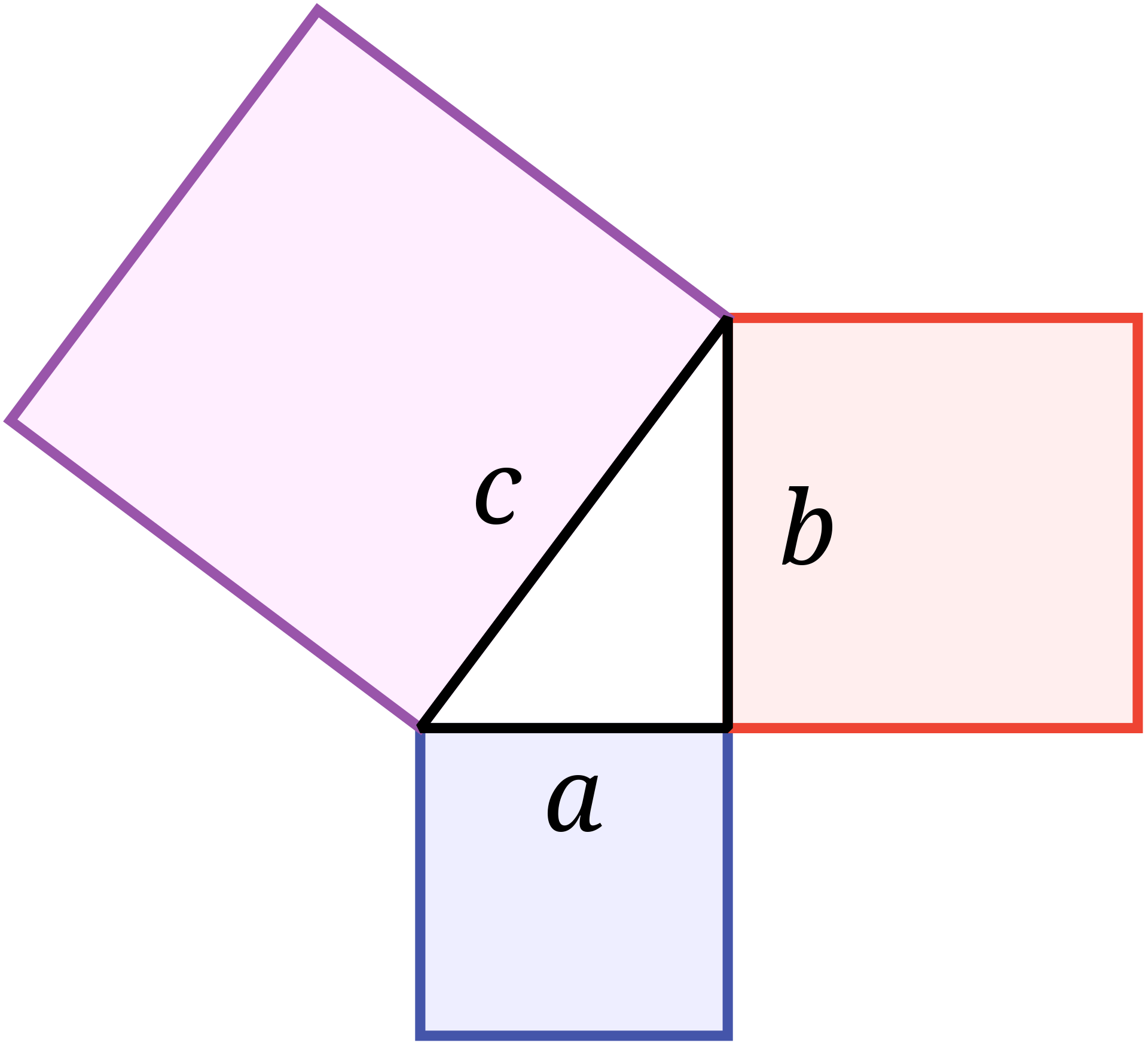
Every few months, someone posts, “Another day has passed and I still haven’t used the Pythagorean theorem.”
This is funny, and also wrong in the most modern possible way.
You did not sit at breakfast and say, “Ah, yes, a^2 + b^2 = c^2, therefore I shall drink coffee.” Fine. But you opened your phone. Your phone found your location. Your maps app calculated the distance. Your camera compressed an image. Your bank app authenticated your face. Your Spotify recommendation system placed you in a very large invisible space next to people who also like sad music and productivity podcasts. Then you asked ChatGPT to write an email that made you sound polite but not weak.
Congratulations. You used Pythagoras before lunch.
Not directly, of course. That is the point. Civilization does not work because everyone uses every theorem consciously. Civilization works because some ideas become infrastructure. You do not “use” the Pythagorean theorem the way you use a spoon. You use it the way you use concrete, GPS, Wi-Fi, and electricity, as a hidden layer underneath the visible thing.
People look at ChatGPT and see language. Words. Essays. Poems. Strategy memos. Bad LinkedIn posts with too many emojis. They think: “This is a writing machine”, but underneath, it is mostly geometry wearing a costume.
Which means that, in a very real sense, the LLM is built from old bricks.
First brick: geometry.
The Greeks asked, “How do we measure distance? What is a triangle? What is space?” Pythagoras gives you the relationship between sides. It looks like school torture, but it is actually one of the first operating systems for measurement.
Second brick: algebra.
Instead of measuring one triangle, we generalize. We use symbols, we stop solving only this problem and start solving classes of problems. Mathematics becomes reusable code before code exists.
Third brick: calculus.
Now we can measure change, slopes, rates, and optimization. If something is wrong, how do we adjust it slightly so it becomes less wrong? This matters because training an AI model is basically making a prediction, seeing how wrong it was, adjusting billions of tiny knobs, repeat until the machine becomes disturbingly useful.
Fourth brick: linear algebra.
Now the world becomes vectors and matrices. Images, sounds, words, preferences, prices, behavior, all can be represented as numbers in high-dimensional space. The spreadsheet becomes the universe. This is where Pythagoras quietly returns, because distance in vector space is still a cousin of that old triangle problem.
Fifth brick: statistics and probability.
The model does not “know” the next word. It estimates, it ranks possibilities. It says something like “given everything I have seen, this token is more likely than that token”. Intelligence, at least commercially, becomes a probability distribution with a nice interface.
Sixth brick: compute.
For centuries, these ideas were beautiful but slow. Then we got chips, GPUs, data centers, cloud infrastructure, cheap memory, and obscene amounts of electricity. The math was old. The scale was new.
Seventh brick: the transformer.
Attention is the trick. Not attention as in “students should pay attention”, though yes, they should. Attention as in “which words matter to which other words?” in the sentence “the company missed earnings because it overspent on GPUs”, the model learns that “overspent” and “GPUs” are doing a lot of work. The machine learns relationships between tokens, not one word at a time, but across context, and then suddenly the bricks become a building.
A theorem about triangles becomes geometry. Geometry becomes vectors. Vectors become embeddings. Embeddings become language models. Language models become copilots, tutors, analysts, therapists, interns, consultants, coding assistants, search engines, and occasionally very confident machines that hallucinate court cases.
In conclusion, another day has passed, and you did not manually calculate the hypotenuse, but another day has also passed in which descendants of that idea ran your world.
This is the joke about education that people miss. The point of learning Pythagoras is not that one day your boss will burst into the room and shout, “Quick, Sorin, calculate the diagonal of this rectangle or the company dies”. The point is that knowledge compounds. School gives you bricks before you know what building they belong to. Of course, most bricks look useless when held alone.
A derivative looks useless until you understand optimization. A matrix looks useless until you understand machine learning. Probability looks abstract until you understand risk, markets, diagnosis, fraud detection, or AI. The Pythagorean theorem looks childish until you realize modern computing is full of distance, similarity, error, and geometry.
The miracle is that this wall eventually stands, and then everyone walks past the wall and says “Why did I have to learn about bricks?”