[PRINCIPLE] Speed wins

Each competition favors the one who moves with purpose and swiftness. Delay grants the opponent time to gather strength and shape the field. A decisive step unsettles resistance and creates advantage before it can be measured. Movement guided by judgment turns uncertainty into opportunity. Train the mind to act with clarity and readiness. Prepare […]
You need the ‘long form’

Each idea begins as a fragment and seeks a fuller shape through patient expression. Short thoughts capture attention, yet depth requires space and continuity. A mind that extends its thinking in long form uncovers connections that remain hidden in brief reflection. Understanding grows through sustained effort and careful articulation. Give your thoughts the room […]
[PRINCIPLE] You have to write the Playbook

Each path appears unclear at the beginning and no guide contains the full course. A playbook emerges through attention, effort, and reflection. The mind that waits for instruction remains dependent, while the mind that observes and records begins to shape its own method. Order arises from practice, and wisdom forms through repeated action guided […]
Nobody knows what they are doing

Each person moves through life with partial sight and changing judgment. Knowledge grows through action, not before it. Even those who appear certain refine their path as they proceed. The world reveals itself step by step, and wisdom consists in seeing clearly what is in front of you rather than claiming mastery over what […]
Indecision as a burden

Each postponed choice gathers weight within the mind and clouds judgment. Unmade decisions accumulate like unfinished tasks and quietly shape the course of life. Attention fragments and energy leak into worry rather than action. A clear mind favors timely judgment and accepts the limits of perfect knowledge. Every decision made with care restores order […]
Bad news travels fast

Bad news moves swiftly because the mind is drawn to what threatens order. The crowd gathers around fear as if it were a fire that must be watched. Rumor gains strength through attention and repetition. The wise person observes this current and remains steady. Judgment stays anchored in reason rather than in the […]
Small teams, Sharp edges

Small teams, Sharp edges When a problem looks big, the instinct is to make the team bigger. More meetings. More stakeholders. More alignment decks. But every additional person doesn’t just add capacity. They add coordination cost, noise, politics and more delays. Most hard problems need more clarity, not people. Small teams move faster because they […]
Why Europe doesn’t have a Tesla
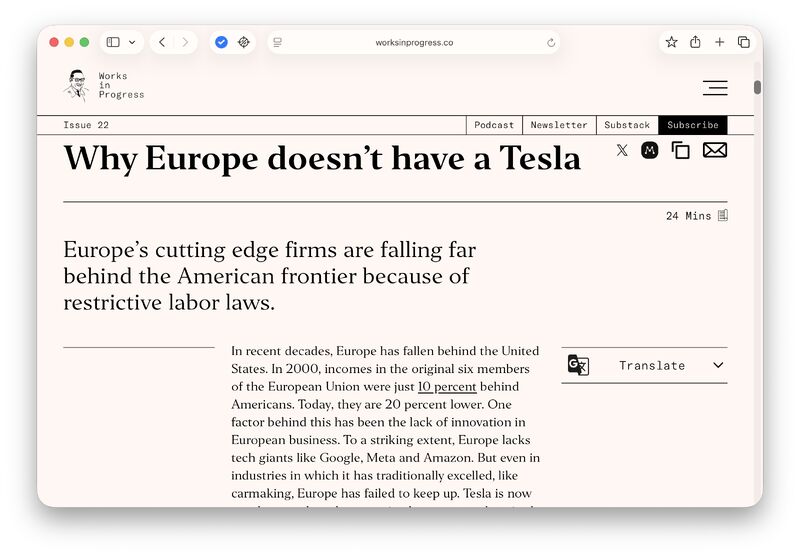
When the cost of failure is too high, disruption becomes irrational The core argument is straightforward but uncomfortable. Europe’s problem is not talent, capital, or even ambition… it is optionality. When the cost of failure is measured in 31 to 62 months of salary per employee in major economies, compared to seven in the […]
The Sorting Advantage

Most of what we call “work” is sorting. Sorting signal from noise. The customers who fit from the ones who don’t. The “good enough” from the “worth it”. The mistake is lazy sorting: choosing proxies because they’re easy to count, not because they’re true. Metrics that look scientific but measure the wrong thing. Rankings […]
How AI Agents are breaking the SaaS seat model

Enterprise software has been priced for a world where humans were the bottleneck. Seats worked because headcount was a reliable proxy for work: hire more support reps, buy more Zendesk licenses; expand sales, add Salesforce users; scale finance, add ERP access. The model was simple, predictable, and incredibly profitable. AI agents change the underlying […]