
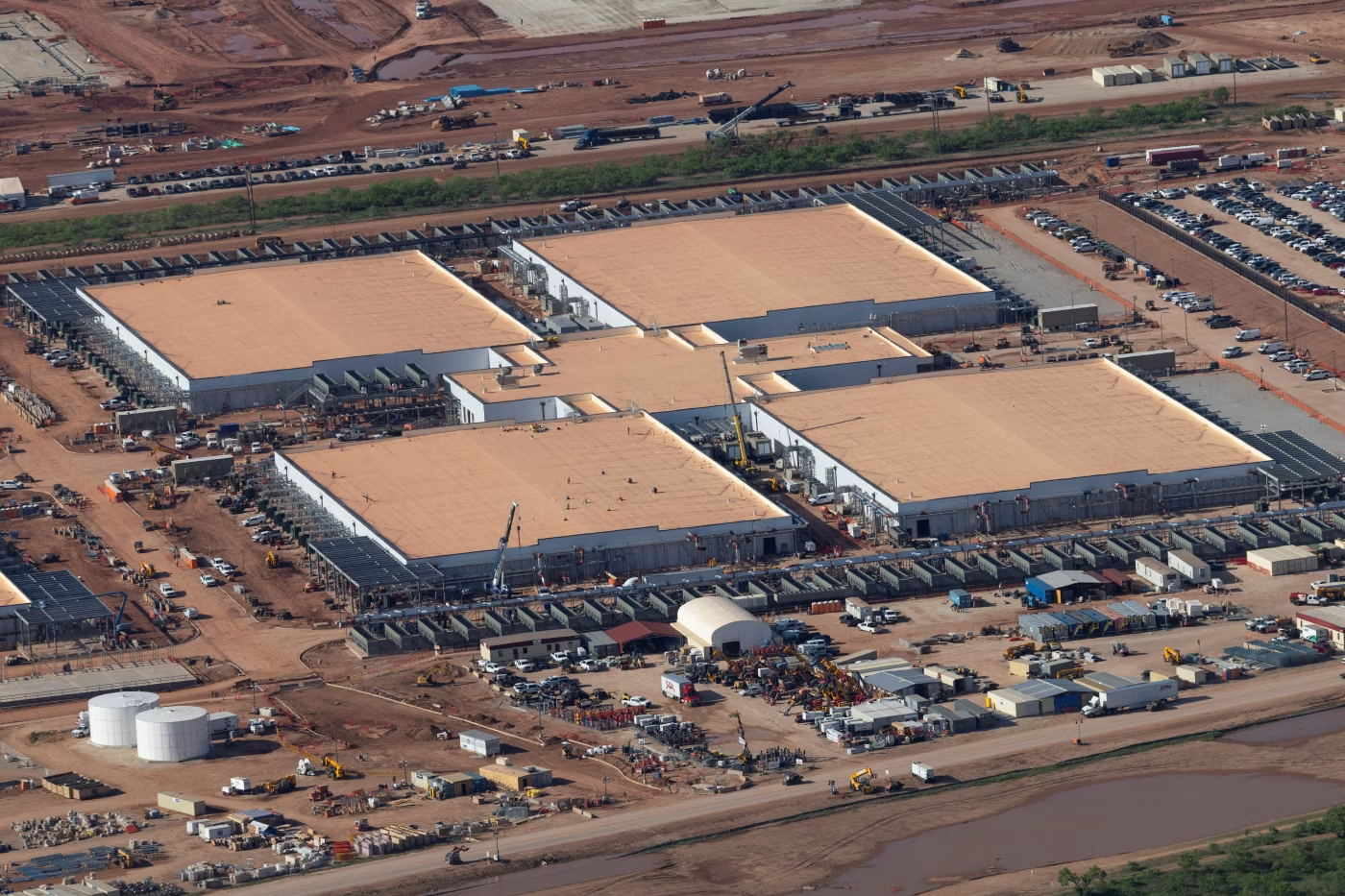
GPUs are the tulips of our time: scarce, beautiful, and rapidly depreciating (ie. 1 – 3 years). They’re not durable infrastructure, but they’re the speculative steel beams of a half-finished cathedral. Data centers last longer, but even those will look old/outdated once the next wave of compute efficiency hits. The real prize, the one that outlasts every crash, will be power.
Every major technological bubble leaves behind an unintended gift: the infrastructure of the next economy. The railway mania of the 1840s bankrupted half of London’s merchant class, but it left behind the arteries of industrial Britain. Investors lost their shirts, but the world gained railroads, which led to physical compounding in action. The telegraph boom of the 1860s gave us global communication; the canal mania of the 1790s cut the cost of moving goods by an order of magnitude.
The dot-com bubble did the same. Cisco’s market cap collapsed, but the world woke up with transoceanic fiber, redundant data centers, and millions of miles of optical cable that made Facebook, Netflix and AWS possible. Every speculative frenzy misallocates capital in the moment and allocates it perfectly in hindsight.
Today, AI is following the same playbook. Nvidia’s valuation is the speculative heat. Today, the bottleneck is power. Large models consume megawatts; inference at scale requires reliability measured in gigawatt-hours. We’re already seeing “AI-only power plants” on the drawing board. Hyperscalers quietly signing 20-year PPAs with nuclear startups and geothermal sites. OpenAI’s next model will likely consume more electricity than a small European country.
So the market, in its infinite irrational wisdom, is solving the wrong problem and will fix the right one as a side effect. Every dollar of overvaluation in AI chips accelerates CAPEX in transformers, cooling, and transmission. The venture dollars chasing AI infrastructure are underwriting the next wave of energy abundance.
It’s worth remembering: capital misallocation is how progress happens. The 19th-century railroad booms built too many tracks to unprofitable towns, but those tracks later moved the coal, wheat, and soldiers that made empires. The dot-coms built fiber they couldn’t monetize and then Google did.
When the AI bubble bursts, and it will, we’ll be left with a global network of hyper-efficient data centers, upgraded transmission corridors, and private power lines. A grid dense enough to run models, but versatile enough to electrify heavy industry, power vertical farms, or store intermittent renewables.
That’s the real dividend of mania: durable capacity born from ephemeral hype.
GPUs will depreciate. Startups will die. Valuations will deflate. But the substations, the SMRs (small modular reactors), and the superconducting lines will still hum quietly, efficiently, for the next fifty years.
Ultimately, the AI boom will not only provide us with smarter software. It will give us more power literally.


